
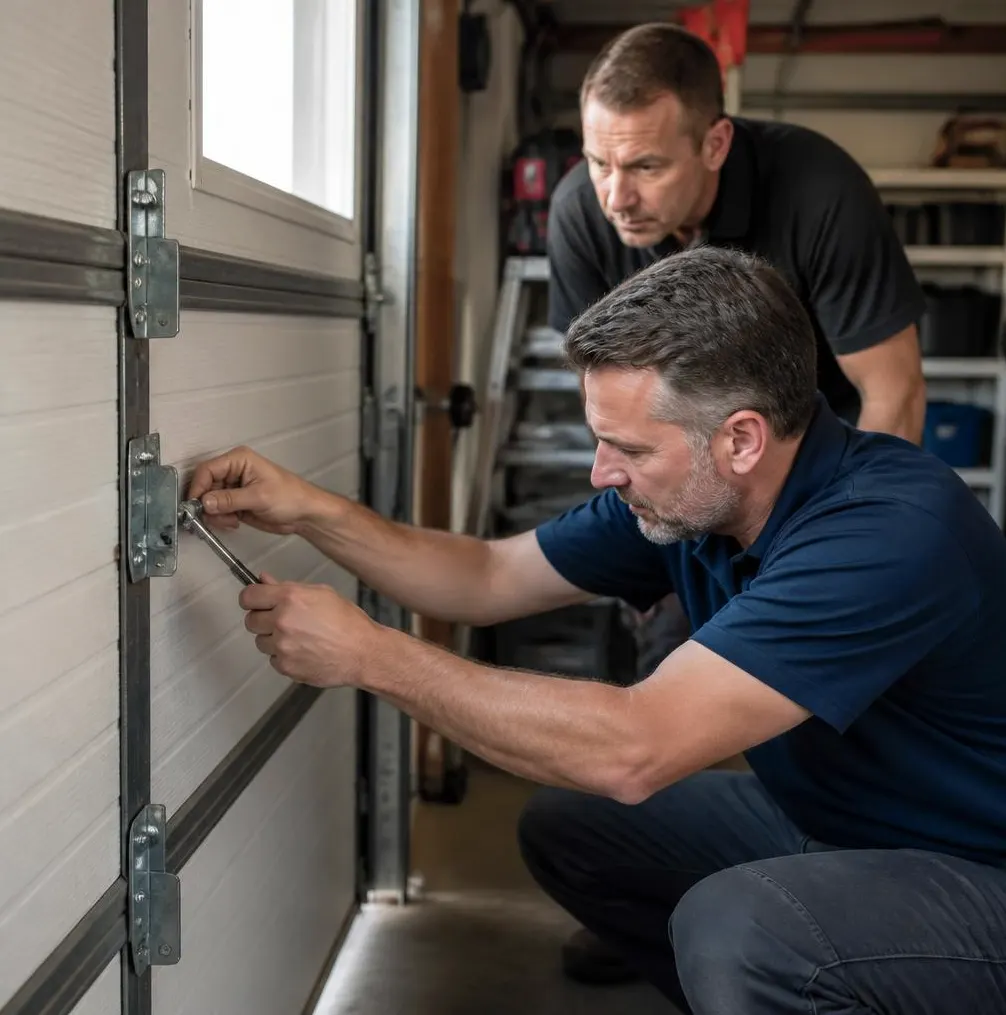
What This Looks Like on a Service Call
A typical call starts the same way: the homeowner presses the remote, the door rolls down a foot or two, then suddenly reverses and goes back up on its own. Sometimes the door won't even attempt to close — the opener motor hums, a light blinks on the wall control, and nothing moves. Out here in Acton and the rest of the Antelope Valley, this tends to show up more after a stretch of hot, dry, dusty days, or right after the Santa Ana-type winds kick dust and debris around garages and driveways. By the time a technician gets there, the pattern is usually consistent enough to point straight at the cause.
Causes, Checked in the Order a Technician Would Check Them
1. Dirty or Misaligned Safety Sensors
This is the first thing any technician checks, because it's the most common cause by far. Every garage door opener installed in the last few decades has two small photo-eye sensors mounted a few inches off the floor on either side of the door. If the beam between them is broken, blocked, or even slightly misaligned, the opener treats it as an obstruction and reverses the door — or refuses to close it at all. In this part of California, dust accumulation on the sensor lenses is a routine problem, especially during the dry season when fine dust and occasional wildfire smoke settle on everything in the garage. A quick fix is wiping both lenses clean with a soft cloth and checking that the indicator lights on each sensor are solid, not blinking. If one sensor has been bumped — by a bike, a trash can, or a parked car — it may need to be physically realigned so both units face each other directly.
2. Damaged or Chewed Sensor Wiring
If the lenses are clean and aligned but the door still won't cooperate, the next check is the wiring running to each sensor. Rodents get into garages more often than people expect, particularly in homes near open desert lots, and they'll chew through thin sensor wire without much trouble. Sun exposure and heat cycling can also make older wire insulation brittle and crack at the staples. A technician will test continuity on the wire and replace any damaged runs rather than patch them, since a partial short will cause intermittent reversing that's hard to diagnose later.
3. Something Physically in the Door's Path
Before touching any settings, a technician rules out an actual obstruction — a bike, a garden hose, a buildup of leaves or gravel in the track. This sounds obvious, but a bent bracket or a small rock wedged in the track can cause a reversal that looks electronic but is purely mechanical.
4. Limit and Force Settings Out of Adjustment
Every opener has travel limits (how far the door should move) and force settings (how much resistance it allows before reversing). If these drift out of adjustment — which happens naturally over time, or after a opener battery backup swap or firmware reset — the door may stop short of the floor and reverse because it thinks it's hit something. Adjusting these is a matter of running the opener's programming sequence and testing the door through a few full cycles, watching where it stops and how much force it takes to trigger a reversal.
5. Worn or Unbalanced Springs
If the door is heavy to lift by hand, or it reverses closer to the floor rather than partway down, worn torsion springs are often the real culprit. As springs lose tension, the opener has to work harder to move the door, and its safety mechanism interprets that extra strain as an obstruction and reverses it. Spring wear is gradual and tends to show up as a slow decline — the door reverses a little more each week until it won't close at all. This isn't a DIY fix; torsion springs are under heavy load and need to be replaced with the correct size and wound to the right tension, which is exactly what our Spring Replacement service handles.
6. Bent Track or Roller Problems
Tracks can get knocked out of alignment by a car bumper, a dropped tool, or even gradual settling of the structure — something worth watching for in homes that have had earthquake retrofit work done, since bracket positions can shift slightly over time. A bent track causes the door to bind at a specific spot, which the opener reads as resistance and reverses on. Rollers that are worn, cracked, or missing lubrication can cause the same jerky movement. Fixing this means straightening or replacing the track section and swapping worn rollers rather than just adjusting the opener around the problem.
7. Opener Logic Board Failure
If every mechanical and sensor check comes back clean and the door still won't behave, the opener's internal circuit board may be failing. This is more common in older units, especially ones that have endured a few summers of heat buildup in an uninsulated garage. At that point, replacing the opener is usually more cost-effective than repairing a board that's likely to fail again soon.
When to Call Acton Garage Door
If cleaning the sensors and clearing the track doesn't solve it, or if the door is noticeably harder to lift than it used to be, it's time to call in a technician rather than keep adjusting settings by trial and error. Our Garage Door Repair service covers sensor, wiring, and track diagnostics on the spot, and if worn springs are behind the trouble, we handle Spring Replacement safely with the right parts for your door's weight and size. A door that won't close reliably is also a security gap, so if it happens after hours, our Emergency Garage Door Service gets someone out without waiting until morning.
If your garage door in Acton is reversing, sticking, or refusing to close, call Acton Garage Door for a straightforward diagnosis and a fix done right the first time.